


Dhiraj Kandel
Managing DirectorSchedule a free consultation with our expert counselors to discuss your study
The essentials at a glance
You can apply for a Canada working visa from Nepal with a job offer from a Canadian employer, or through an open work permit if you fit a listed group. The main open route from Nepal is for the spouse of an eligible student or worker, as most other people abroad can't get one. This page covers who qualifies, the documents, the fees and each step.
Main points from this page
A Canada working visa from Nepal is really a work permit, and it comes in 2 types: employer-specific and open.
People in Nepal often say “work visa”, but Canada’s immigration office, IRCC, uses the words “work permit”. The permit lets you work. A visitor visa lets you travel to Canada, and IRCC gives you that with an approved permit if you need one. This guide sits under our main page on study in Canada from Nepal.
| Permit type | Job offer? | What it means for you |
|---|---|---|
| Employer-specific work permit | Yes | You work for the employer, in the job and place printed on your permit. |
| Open work permit | No | You can work for almost any employer, but only certain people can get one. |
IRCC says the employer-specific permit is the most common type. Its short online questions also tell you which permit fits you, so start there.
Yes, but only in certain situations, because IRCC says most people applying from outside Canada can’t get one.
This is the point many people miss. You can’t apply just because you want to work in Canada. IRCC’s open work permit page says eligibility is limited, and that most applicants apply from inside Canada.
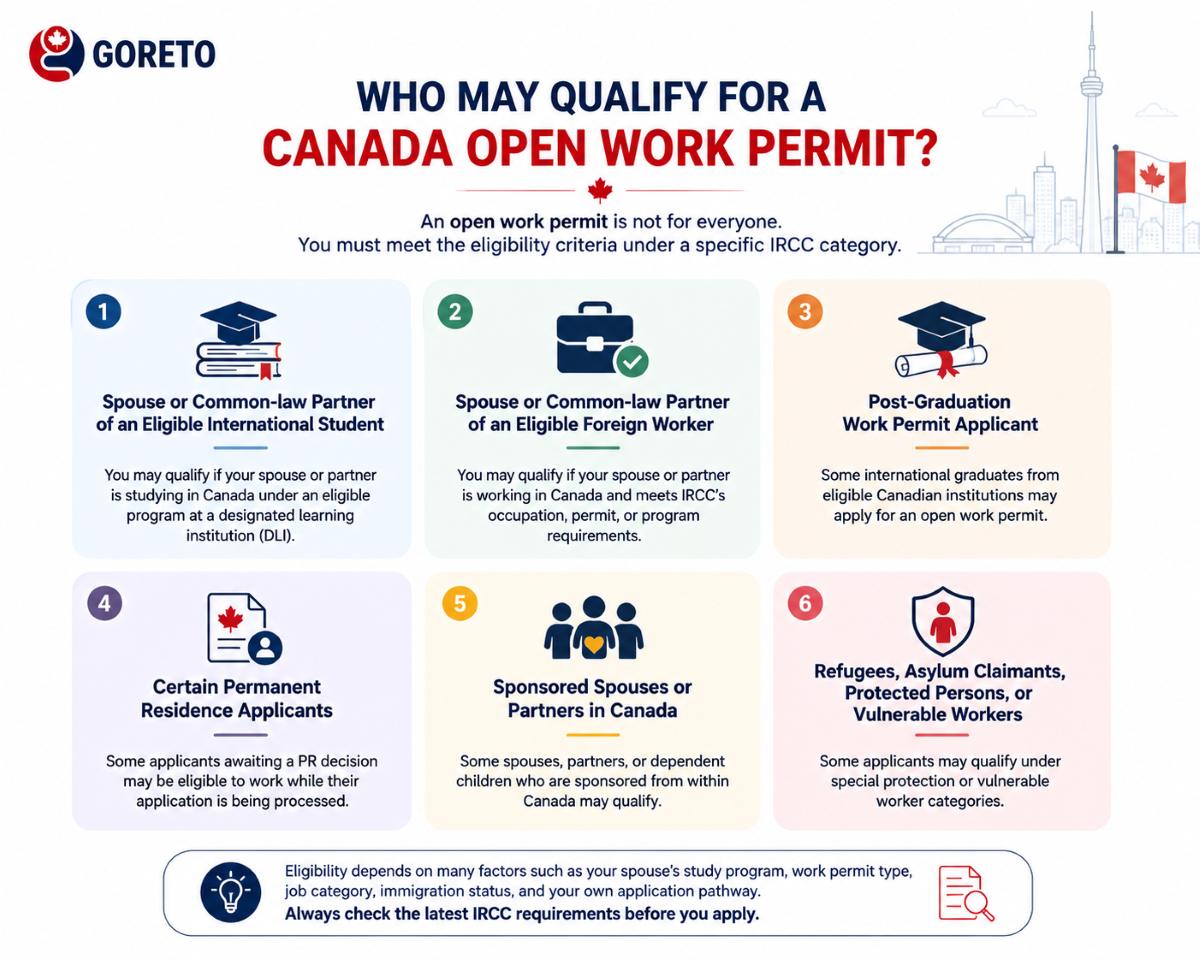
Here is how the 6 main groups look for someone from Nepal:
| Group | What it means for you |
|---|---|
| Spouse or partner of an eligible student | The main route from Nepal. The rules are in the next section. |
| Family member of an eligible worker | Another route from Nepal. It depends on your family member’s job and permit. |
| Graduates of Canadian study | You study in Canada first, then apply for a Post-Graduation Work Permit (PGWP). |
| Permanent residence applicants and sponsored family | This is for people who have already started a permanent residence or sponsorship case. |
| Refugees, protected persons and workers facing abuse | These are special protection groups, not a normal route from Nepal. |
| Working Holiday (International Experience Canada) | Nepal isn’t on IRCC’s list of countries for this program. |
Yes, if you hold a valid study permit and study in a program that IRCC lists.
These rules started on 21 January 2025. IRCC’s page for students’ spouses lists them:
Most college diplomas and other bachelor’s degrees aren’t on this list. A post graduate diploma in Canada is one example. So if your spouse needs this permit, check the list before you pick a course.
Your spouse’s permit usually lasts as long as your study permit. Your spouse sends your school letter or transcripts, plus proof of your relationship. Our Canada dependent visa guide covers the family rules in more detail. If you apply together, also read the proof of funds guide.
Your spouse may qualify if your job level and the time left on your permit match IRCC’s rules.
Canada gives each job a TEER level from 0 to 5. A lower number usually means the job needs more training. You can find your job’s code and TEER level on IRCC’s site. Then compare it with IRCC’s rules for workers’ family members:
| Your situation in Canada | Who may apply | Time left on your permit |
|---|---|---|
| TEER 0 or 1, or a listed TEER 2 or 3 job | Spouse or partner only | At least 16 months |
| Your permit came from your economic permanent residence application | Spouse, partner and dependent children | At least 6 months |
| TEER 4 or 5 job, on a listed path to permanent residence | Spouse, partner and dependent children | At least 6 months |
| TEER 4 or 5 job, with no listed path to permanent residence | No new family applications | Not eligible |
The time is counted from the day IRCC receives your family member’s application. Some pilots and Quebec health programs have their own rules. A student working off campus without a work permit doesn’t count as a worker here.
Yes, you can apply for an employer-specific work permit if a real employer in Canada offers you a job.
Most jobs need a labour market impact assessment, or LMIA. This paper proves the employer needs to hire a foreign worker. Your employer applies for it and gives you the LMIA letter.
Some jobs don’t need one, and your employer gives you an offer of employment number instead. IRCC explains both, and you can look for jobs on Job Bank for foreign candidates. The IRCC fee for this permit is CAD 155.
Please be careful with job offers from agents. IRCC warns that no one can promise you a job or a visa. It also warns about websites that offer high-paying jobs for a fee. Canada’s employment department says employers can’t make you pay to get or keep your job.
Before you pay anyone for immigration advice, check that they hold a licence. IRCC requires a paid representative to be licensed, and this covers consultants too.
You apply online through an IRCC account, then give biometrics and wait for a decision.
This is the order on IRCC’s page for applying from outside Canada:
You need a medical exam if you will work in a job that protects public health, such as health care, a school or child care. You also need one for a stay over 6 months if you recently spent 6 months in a row in a country on IRCC’s list. Your document list will show what IRCC wants from you.
Everyone needs the main form, a passport copy and a photo, and the rest depends on your group.
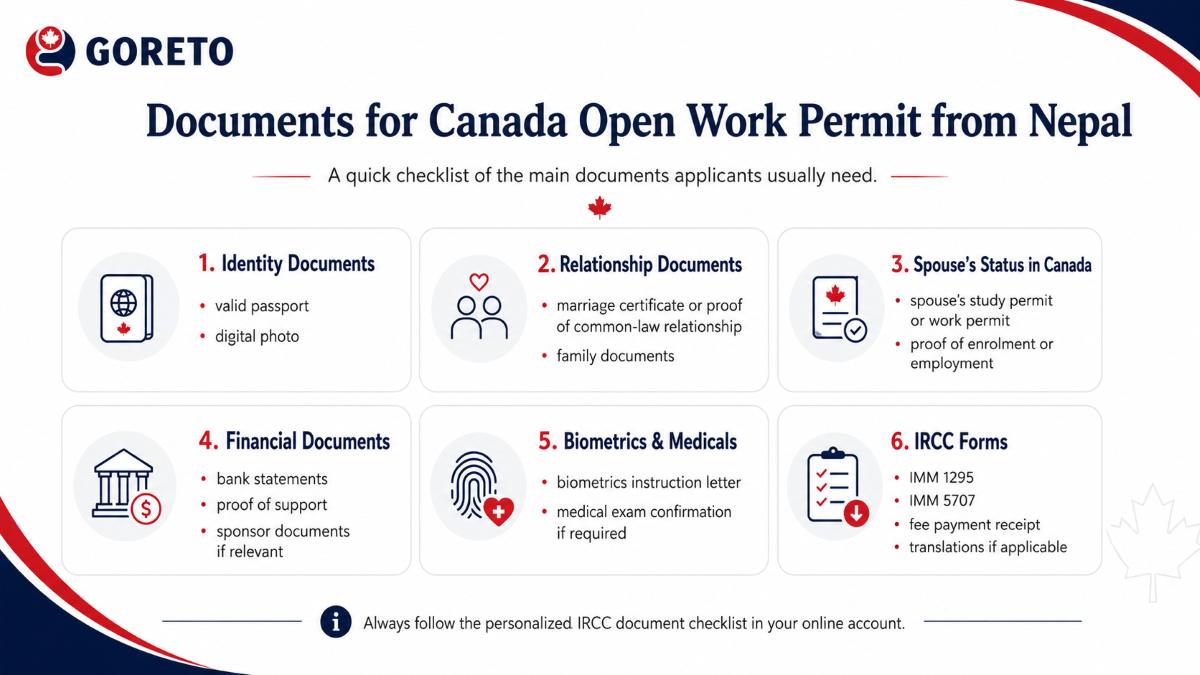
IRCC’s account gives you a personal list, so follow that first. IRCC’s forms page and the family rules above give this general picture:
| Document | When you need it |
|---|---|
| Form IMM 1295, the work permit form | Everyone |
| Copy of a valid Nepal passport | Everyone |
| One photo that meets the visa rules | Everyone |
| Family Information Form, IMM 5707 | If your list asks for it |
| Marriage certificate, or Form IMM 5409 for a common-law partner | Spouses and partners |
| Birth or adoption papers | Dependent children |
| Your spouse’s study permit and enrolment letter or transcripts | Spouses of students |
| Your family member’s work permit and employer letter with the TEER level | Family of workers |
| Proof of money, such as a bank balance certificate | If your list asks, or to show you can support yourself |
| Police report | If IRCC asks |
| Certified English or French translations | Any paper in Nepali or another language |
| Form IMM 5476 | If a representative applies for you |
If the portal asks an open work permit applicant for job papers, upload a blank page marked “Not applicable”. An employer-specific file is different. It needs a CV, an experience letter, proof of past work and the job contract.
The IRCC fee is CAD 255, or CAD 340 with biometrics for one person.
These amounts come from IRCC’s fee list:
| Fee | Amount |
|---|---|
| Work permit processing | CAD 155 |
| Open work permit holder fee | CAD 100 |
| Biometrics, one person | CAD 85 |
| Biometrics, family applying together | CAD 170 at most |
So CAD 340 is about Rs 36 thousand. Check today’s value on our CAD to Rs forex converter. An employer-specific permit doesn’t have the CAD 100 fee. The medical exam, translations and travel cost extra.
You also need enough money for yourself, your family and the trip home. IRCC doesn’t set one figure for this. It depends on your family size, the place you will live and your permit program.
IRCC’s waiting time changes often, so check its page, and common refusal reasons include missing papers and weak ties to Nepal.
We don’t give a fixed time here, because IRCC’s processing times page changes often. An officer first checks that your file is complete. IRCC says an incomplete file is refused without further processing. The officer may then ask for an interview, a medical exam or more papers.
These are 5 common reasons that IRCC lists for a refusal:
You can usually apply again unless your letter says otherwise. It only helps if you add something new that answers the refusal reason.
You get a letter first, and the officer at the border prints your actual work permit.
This letter is called a port of entry letter of introduction, and it is not your permit. You also get a visitor visa if you need one. Bring these to the border:
The officer makes the final decision. Read your permit before you leave the border, and ask about any mistake right away.
Your next step is a Social Insurance Number, which you need for work in Canada. For temporary residents, it starts with 9 and ends with your immigration papers.
IRCC also says to have provincial cover or money for medical care. Our guide to health insurance in Canada explains the basics, though it is written for students. A permit can’t last longer than your passport or biometrics, so check those dates too.
You can work for almost any employer, apart from 2 groups that IRCC bans.
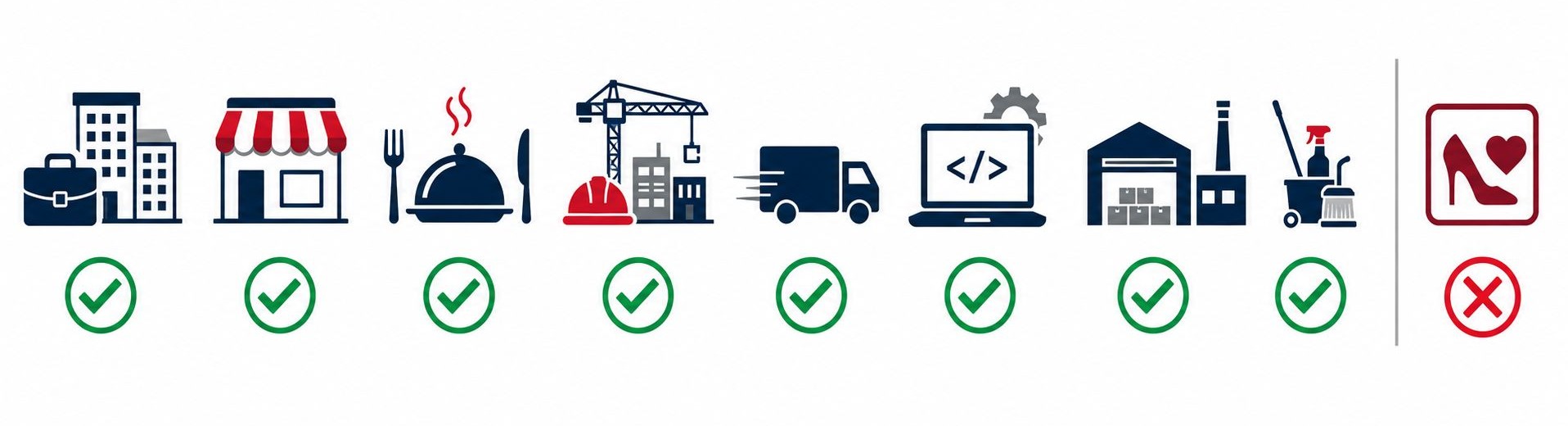
The banned groups are employers on the non-compliant employers list and businesses that regularly offer striptease, erotic dance, escort services or erotic massages. You can change jobs without a new permit, because your permit isn’t tied to one job.
Your permit can still carry limits, so read it carefully. Without a medical exam, it may stop you from working in health care, schools or child care. Some permits also limit you to one province. You must follow whatever is printed on it, and you must leave or apply to extend before it ends.
Many Nepali students build a work route by studying in Canada first.
As a student, you can work up to 24 hours a week off campus while classes are on. Our page on student work hours in Canada explains this. After you finish an eligible program, you can apply for the PGWP. That time can also help with PR pathways through education, though nothing is automatic.
Start with the Canada student visa requirements and your IELTS or PTE score. If you are comparing advisers, see how to pick the best consultancy for Canada. Goreto has branches in Kathmandu, Lalitpur, Chitwan, Itahari and Pokhara, and you can talk to a counselor about a study plan that fits your family.
You need either a job offer for an employer-specific permit, or to fit a listed group for an open work permit. Then you apply online through an IRCC account.
Not quite. The work permit lets you work in Canada. The visitor visa lets you travel there, and IRCC issues it with your approval if you need one.
Only if you fit a listed group, such as the spouse of an eligible student or worker. IRCC says most people applying from outside Canada can’t get one.
Usually not on this permit. The spouse rule covers master’s programs of 16 months or longer, doctoral programs, listed professional degrees and a few named programs.
Dependent children may qualify only where the working parent is on an eligible path to permanent residence. Since 21 January 2025, the route without that path is for spouses and partners only.
The fee is CAD 255. That is CAD 155 for processing plus CAD 100 for the open work permit holder fee. Biometrics add CAD 85 for one person.
IRCC’s general document list doesn’t name an English test for an open work permit. An employer may still ask for English, and study or PGWP routes have their own rules.
Yes. Your permit isn’t tied to one job, so you can move to another eligible employer. Just follow any limits printed on your permit.
It varies. A student’s spouse usually gets the same end date as the study permit. A permit also can’t last longer than your passport or biometrics.
Reference links
Important guidance note
This page provides general guidance about studying abroad. Requirements, fees and policies can change. For advice about your situation, speak with a Goreto counselor before applying.



Book Your Free Consultation
From choosing the right country to finding scholarships and housing, our counselors will guide you at every step.
Choose the right country based on your goals
Find courses that match your career plan
Get guidance on colleges and universities
Plan your finances, scholarships & part-time jobs
Plan your abroad stay & post-study plan

Schedule a free consultation with our expert counselors to discuss your study

Schedule a free consultation with our expert counselors to discuss your study